CoSIR Learning to collaborate
Training LLMs for Multi-Agent Collaboration with Verifiable Information Rewards
arXiv preprint · October 13, 2026
Abstract
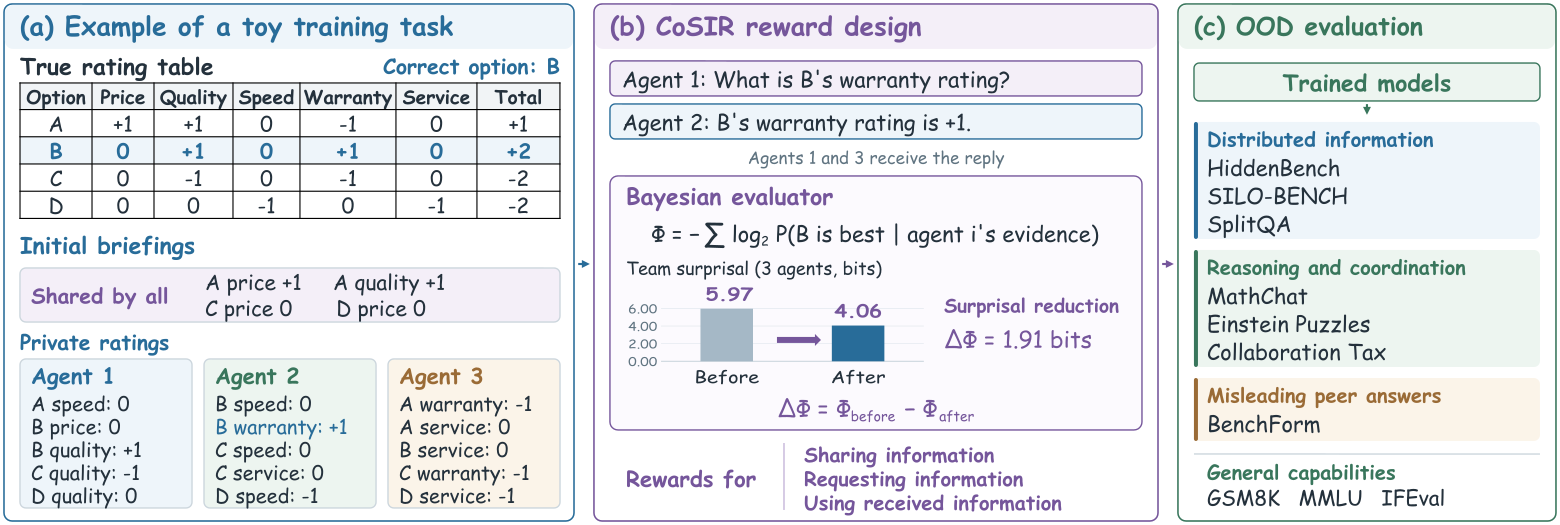
Effective collaboration among large language model (LLM) agents in multi-agent systems requires sharing relevant evidence, requesting missing information, and incorporating teammates' contributions into decisions. Training these behaviors is challenging because final task outcomes provide limited feedback on the value of individual messages. We introduce CoSIR (Collaboration via Surprisal-based Information Rewards), a post-training approach that uses a simple, verifiable environment to teach collaboration behaviors that generalize to more complex, unseen tasks. We propose a Bayesian evaluator that scores shared information by its reduction in team surprisal, defined as the sum of the negative log probabilities assigned to the correct option given each agent's available evidence. Requests are scored by the potential reduction in the same quantity if the requested information were truthfully provided. Separate rewards encourage agents to use the received information in their private choices and calculations. We post-train Qwen3-4B, Qwen3-8B, and Gemma-3-4B-it through self-play and evaluate transfer to seven unseen natural-language collaboration tasks. CoSIR achieves the highest aggregate score, while its performance in general tasks remains competitive. Behavioral analyses show increased disclosure of private evidence and fewer judged failures to use teammates' input.
Original abstract · arXiv:2610.17893v1
Problem statement
A team can collectively hold the information needed to answer a question and still fail to use it. One agent may withhold a useful fact, another may proceed without asking for missing evidence, and a third may ignore a teammate’s correction. A final success or failure reward gives limited feedback about which messages helped.
CoSIR asks whether these behaviors can be learned in a simple environment where the value of information is verifiable, then transferred to unfamiliar collaboration tasks.
Method
Agents receive different parts of a rating table and exchange messages before choosing the best option. Because the facts and their distribution are known, a Bayesian evaluator can calculate how a shared rating changes the probability of the correct option given each agent’s available evidence. The reward measures the reduction in team surprisal, the sum of the negative log probabilities assigned to that option.
A request is rewarded for the potential reduction in the same quantity if the requested information were truthfully supplied. Separate rewards assess whether the agent uses available evidence in its private choices and calculations. Self-play then updates a policy shared by the agents. The evaluator tracks evidence; it does not read the language model’s internal beliefs.
Key findings
1. Collaboration training transfers to unseen tasks
CoSIR improves the mean score over the base model on all seven tasks for all three backbones. Each task is evaluated over four runs. SUM is the equally weighted sum of seven task means on 0–100 scales, rather than an accuracy percentage. Table 1
| Backbone | Base SUM | CoSIR SUM |
|---|---|---|
| Qwen3-8B | 352.60 | 384.44 |
| Qwen3-4B | 333.17 | 357.87 |
| Gemma-3-4B-it | 208.02 | 235.94 |
2. Message-level information rewards add value beyond outcome rewards
Relative to Outcome-RL, CoSIR gains 20.72, 22.95, and 24.86 SUM points for Qwen3-8B, Qwen3-4B, and Gemma-3-4B-it, respectively. This comparison keeps the training environment, initialization, and request demonstrations the same while changing the reward. Sections 4.1–4.2
3. More private evidence enters the discussion
For Qwen3-8B on HiddenBench, private-fact disclosure rises from 68.5% to 74.3%, and responses to teammates rise from 59.4% to 65.8%. These measures consider any discussion round; first-message disclosure is a separate measure. Table 2
One paired SILO-BENCH case illustrates why sharing evidence matters. A trained agent gives an incorrect count but also supplies its list, allowing a teammate to check and correct it. The CoSIR team answers 5, correctly; the base team repeats unsupported counts and answers 18. This is an illustrative case from seed 1, not an aggregate result. Appendix L, Figure 3
4. Some communication failures become less frequent
Pooled across three models on HiddenBench, SplitQA, and MathChat, the judge-assessed rate of ignoring other agents’ input falls from 26.3% to 22.8%. Proceeding without clarification falls from 36.4% to 32.0%. These are MAST failure labels assigned by an evaluator. Table 3
5. General benchmark scores remain close in the tested suite
Across GSM8K, MMLU, and IFEval, changes from the base model to CoSIR range from −0.6 to +0.8 percentage points. This comparison tests three general benchmarks; it does not establish preservation of every model capability. Appendix I, Table 8
Relation to prior work
ToM and TalkHier change how agents reason or communicate at inference time. CoSIR changes the model through post-training. The evaluation matches agent counts and public speaking turns, although ToM and TalkHier can use extra calls within a turn, so inference compute is not fully matched.
Outcome-RL is the controlled comparison for the reward design. A final outcome gives a discussion one overall signal; CoSIR separately values statements, requests, and private answers. Two discussions with the same outcome can therefore receive different training feedback. Related methods such as MAPoRL and MAGRPO also train collaboration, but the reported benchmark table does not directly compare against them.
Limitations
The information reward depends on known facts and a computable evaluator. Extending the same reward to open-ended environments where the complete state is unavailable remains unresolved. Transfer is tested on three backbones and seven collaboration tasks.
CoSIR does not lead on every task. TalkHier has the highest BenchForm score for all three models, and ToM leads Qwen3-8B on SILO-BENCH. Some frequent failures also remain: repeated-step failures change from 85.1% to 85.6%, while specification and system-design failures change from 88.2% to 88.3%. Better information exchange does not resolve all coordination problems. Limitations, Table 3
Resources
BibTeX
@misc{chen2026trainingllmsmultiagentcollaboration,
  title = {Training LLMs for Multi-Agent Collaboration with Verifiable Information Rewards},
  author = {Chen, Keru and Lin, Sen and Liang, Yingbin and Bastian, Nathaniel D. and Zou, Shaofeng},
  year = {2026},
  eprint = {2610.17893},
  archivePrefix = {arXiv},
  primaryClass = {cs.AI},
  doi = {10.48550/arXiv.2610.17893},
  url = {https://arxiv.org/abs/2610.17893}
}